primeideal: Wooden chessboard. Text: "You may see all kinds of human emotion here. I see nothing other than a simple board game." (chess musical)
In 1912, the Saint Anna, led by Lieutenant Brusilov, sets out for the Northeast Passage (it's like the Northwest Passage but less interesting), which has been navigated once before; he's mostly interested in hunting walrus and polar bear, etc. They get iced in and drift north for over a year. Albanov, the navigator, is "dismissed from duty" in late 1913 (but is stuck on the ship with everyone else). Early in 1914 he asks to venture south on his own, to avoid being stuck in another winter. About half the crew volunteers to come with him. Most of his party makes it to the Franz Josef Archipelago to the south, but as they're moving east across the archipelago, people get sick or the party just gets split; only Albanov and Alexander Konrad survive. They get picked up by another Russian polar vessel that's also been out of touch for two years, and when they get back, they have to be informed WWI has started. Albanov kept a diary of his trek, and wrote this up in 1917 using that as a basis; he died two years later, from either typhoid or an exploding munitions boxcar (the Russian Revolution was a fun time).

They had to make their own sledges and kayaks before setting off, because Brusilov didn't have any of that kind of stuff, and Albanov spends a lot of time yelling at the guys not to just leave them behind and go on skis, we actually need these to navigate, fools. I can sort of visualize loading kayaks on sledges to cross ice, but lashing sledges to the kayaks to cross the water gaps is impressive! (Later he talks more about "we lashed them on crosswise," but it was hard for me to visualize at first. They start with five sledges and also five kayaks that take turns riding on each other, it's not five sledge-cum-kayak-vehicles.)

Albanov was definitely a member of the Fridtjof Nansen fan club; they have basically no books on the Saint Anna, but they do have a map of Nansen's travels from "Farthest North." He and Johansen had approached the Franz Josef Archipelago from the east (rather than from the west like Albanov), Albanov is trying to find the supplies where they'd made camp, in the middle.

There's one woman on the Saint Anna, Yerminiya Zhdanko. She was originally hired as a nurse, and apparently took very good care of Brusilov during his illness, but also is the crew's "hostess" at meals. Is this just men defaulting to "oh of course the woman will be doing the ~feminine~ jobs"?

Denisov, a harpooner who stays with the Saint Anna, gets about as much biographical background as anyone. He "was half Ukrainian and half Norwegian." But because this is a Russian narrator writing in 1917, Denisov's father's home is in "the Ukraine," oof.

There's probably a spectrum to draw rating all the expedition leader+second-in-command dynamics. But Brusilov is new levels of awful. His POV on the crew asking to leave:
"At first I tried to talk them out of their plan...A small but increasing number of them decided to stay, more than I actually would have liked, but I did not want to force anyone to leave."
AKA our supplies are so limited, he needs some of the crew to leave so the remaining supplies will go farther, and then too many people stayed back with him.

And here's Albanov shortly before their departure:
Late in the evening the lieutenant called me once more into his cabin to give me a list of items we would be taking with us and which I must, if possible, return to him at a later date. Here is that list as it was entered into the ship's record: 2 Remington rifles, 1 Norwegian hunting rifle, 1 double-barreled shotgun, 2 repeating rifles, 1 ship's log transformed into a pedometer for measuring distances covered, 2 harpoons, 2 axes, 1 saw, 2 compasses, 14 pairs of skis, 1 first-quality malitsa, 12 second-quality malitisi [a footnote explains that malitisi are sacklike garments used in lieu of sleeping bags], 1 sleeping bag, 1 chronometer, 1 sextant, 14 rucksacks, and 1 small pair of binoculars.
Brusilov asked me if he had forgotten to list anything. His pettiness astounded me.
Albanov's general tone throughout (and I guess this is feasible to put into print if all but one of your comrades are dead) is "why am I surrounded by idiots, you are all so lazy, don't sleep, get up and start sledging." But when they leave someone behind who's dying and unable to be carried, he sends a sledge to go back for him. He says that he's become more religious; he carries an icon of Saint Nicholas, and has a dream of him that he interprets as miraculous.

As they're marching across the ice, two guys steal a bunch of supplies on the guise of a "scouting expedition" and disappear. Albanov is furious, but reasons that they can't waste time trying to track them down. A week later, they reach land, it's great, there is fresh food and flowers and everything is wonderful. Turns out the thieves are also there.
My inner voice whispered the oath I had taken to "shoot the ignominous thieves on the spot if ever I encountered them." Anger rose up inside me again. Then I took a closer look at the fellow: He was truly pitiful and his pleas went straight to the heart. I thought of the miracle that had delivered us from an icy death and how I had just now so deeply felt the beauty of the earth and of life, like thought someone brought back from the dead. Swayed by the overwhelming power of such emotions, I decided to pardon the man. Yet had I met him only a few hours earlier, on the ice, I would most certainly have executed him, which alone could expiate his crime.
(But also, Albanov never mentions the names of the two miscreants. Was one of them the one who survived?)

You know how some people really bond together and become friends while facing ordeals together? Yeah nope:
During the most critical moments I was always essentially alone, and it was then that I understood the profound truth of the precept: "It is when you are alone that you are free. If you want to live fight for as long as you have strength and determination. You may have no one to help you with your struggle, but you will at least have no one dragging you under. When you are alone, it is always easier to stay afloat."
I mean, personally, I've definitely...been there. It's just odd to find that expressed as a precept. Maybe it's a Russian thing.

Worsley when they're almost to Elephant Island :handshake meme: Albanov when they're almost to Northbrook Island
not like this, we're so freaking close
During that brief instant, every stage of our journey flashed vividly through my mind with the speed of lightning. I saw the deaths of our three comrades; I saw Lunayev and Shpakovsky carried away in the midst of the storm, and finally myself and Konrad about to be drowned. I can remember exactly what I was thinking: "Who will ever know how we died?" "No one!" I told myself. The idea that no one would ever know how we had fought against these indominable elements, and that our end would remain a mystery forever, was an unspeakable torture to me. My last ounce of strength rebelled against such an unsung disappearance.
Illness triggers the third man factor:
I also had persistent nightmares and imagined that there were three of us on the island. During these mild hallucinations I would get up and hurry over to my sole companion, busy with his excavations, and ask about our third comrade without even knowing who it might be.
But shortly after this, the narrative starts switching between a last-name and a first-name basis for Alexander. :)

The footnotes are detailed and useful, so is the index. (Every time he uses the phrase "white death," take a shot.)
primeideal: Egwene al'Vere from "Wheel of Time" TV (wheel of time)
A little downtime between bingo years, and kind of figured "the only way out is through" when it comes to being weird about polar exploration fandom, so...wandered around a used bookstore and picked up some random titles that looked interesting, there may be more where this came from.

Expedition: the 1865-67 Russian-American Telegraph Company. People had tried to lay a telegraphic cable under the Atlantic Ocean, it didn't last, so another company was like "what if we go up the North American west coast, across the Bering Strait*, then across all of Russia and connect up with the existing telegraph system in Moscow?" So this was part of the exploration/research/preliminary scouting for that. It kind of ends abruptly with "okay never mind, they got the Atlantic Ocean route working after all, let's stop," but hey, that's just capitalism.

This is more of a humorous travelogue with lots of droll tongue-in-cheek, culture shock, wedding-crashers type stuff. Seasickness:
Mahood pretends that he is all right, and plays checkers with the captain with an air of assumed tranquillity which approaches heroism, but he is observed at irregular intervals to go suddenly and unexpectedly on deck, and to return every time with a more ghastly and rueful countenance. When asked the object of these periodic visits to the quarter-deck, he replies, with a transparent affectation of cheerfulness, that he only goes up "to look at the compass and see how she's heading." I am surprised to find that "looking at the compass" is attended with such painful and melancholy emotions as those expressed in Mahood's face when he comes back; but he performs the self-imposed duty with unshrinking faithfulness, and relieves us of a great deal of anxiety about the safety of the ship. The Captain seems a little negligent, and sometimes does not observe the compass once a day; but Mahood watches it with unsleeping vigilance.
(When my grandpa was writing up his recollections of his military experience, decades after the fact, he had some creative euphemisms for seasickness too, maybe this is just a travel literature staple.)

Many of the place names and Russian loanwords didn't have their spelling standardized by this point. Stuff like "yourt" and "toondra" are always in scare quotes, ditto his spelling for balalaika and sastrugi (which is admittedly not a super common word unless you're in polar nonsense fandom...) *And the body of water between Asia and North America is "Behring's Straits" at this point. Early on he complains about Russian transliteration, why is there a "W" in "Wrangell" [Island] or "Wladimir," why would you want to spell this province name "Kamtchatka," nobody pronounces the first "T." So that aged well! (Most of my knowledge of Kamchatka comes from playing, or at least setting up, games of Risk with my brother, who had a line about 'Kamchatka will never forgive you!!')

The word I wish they'd had a translation or gloss for is "verst," which I wasn't familiar with. A verst is 1.07 kilometers, or about 2/3 of a mile.

Nitpick: there are maps in the endpapers, which is great, but it's very zoomed out, a lot of it is the proposed route of the telegraph across the rest of Russia, and the map goes as far south as India and the Arabian Peninsula. Would have been better zoomed in on the area that's actually the focus, but maybe a lot of the smaller settlements didn't have their coordinates mapped...

Obviously Kennan is not a professional anthropologist so take the cultural observations with a grain of salt. I thought the contrast between "the nomads' culture can seem kind of ruthless and harsh to us, but that's a byproduct of the circumstances under which they live, they're as honest and hospitable as anyone else" versus "their cousins who live in settlements are just the worst, most lazy, and terrible" was an interesting parallel to the worldbuilding in cultures like the Outskirters from the Steerswoman series. The details of "these people live in their summer habitations for three months, damming up the river and catching lots of salmon, then go back to their winter village for most of the year," and "the central government of Russia is trying to tax people's fishing harvests so that they have insurance for years when there isn't a good catch" also seem like neat worldbuilding concepts. Maybe for future origfic.
One evening, soon after we left Shestakova, they [dogsled drivers] happened to see me eating a pickled cucumber, and as this was something which had never come within the range of their limited gastronomical experience, they asked me for a piece to taste. Knowing well what the result would be, I gave the whole cucumber to the dirtiest, worst-looking vagabond in the party, and motioned to him to take a good bite. As he put it to his lips his comrades watched him with breathless curiosity to see how he liked it. For a moment his face wore an expression of blended surprise, wonder, and disgust which was irresistibly ludicrous, and he seemed disposed to spit the disagreeable morsel out; but with a strong effort he controlled himself, forced his features into a ghastly imitation of satisfaction, smacked his lips, declared it was "akhmel nemélkhin"--very good, and handed the pickle to his next neighbor. The latter was equally astonished and disgusted with its unexpected sourness, but, rather than admit his disappointment and be laughed at by the others, he also pretended that it was delicious, and passed it along. Six men in succession went through with this transparent farce with the greatest solemnity; but when they had all tasted it, and all been victimized, they burst out into a simultaneous "ty-e-e-e" of astonishment, and gave free expression to their long-suppressed emotions of disgust. The vehement spitting, coughing, and washing out of mouths with snow, which succeeded this outburst, proved that the taste for pickles is an acquired one, and that man in his aboriginal state does not possess it. What particularly amused me, however, was the way in which they imposed on one another. Each individual Korak, as soon as he found that he had been victimized, saw at once the necessity of getting even by victimizing the next man, and not one of them would admit that there was anything bad about the pickle until they had all tasted it. "Misery loves company," and human nature is the same all the world over.
There's also a description of "Anadyr sickness" that's especially common in women, and that's really intriguing in light of what our culture would describe as "mass psychogenic illness." Low temperatures are survivable, but wind is a drag; nobody associates Siberia with mosquitoes, but mosquitoes suck. Many of the cultural allusions went over my head, but hey, he would probably say the same thing about our literature. There are a lot of John Franklin jokes. The Eastern Orthodox liturgy is very moving and they sing Christmas carols too.

A ball at the house of a priest on Sunday night struck me as implying a good deal of inconsistency, and I hesitated about sanctioning so plain a violation of the fourth commandment. Dodd, however, proved to me in the most conclusive manner that, owing to difference in time, it was Saturday in America and not Sunday at all; that our friends at that very moment were engaged in business or pleasure, and that our happening to be on the other side of the world was no reason why we should not do what our antipodal friends were doing at exactly the same time. I was conscious that this reasoning was sophistical, but Dodd mixed me up so with his "longitude," "Greenwich time," "Bowditch's Navigators," "Russian Sundays" and "American Sundays," that I was hopelessly bewildered, and couldn't ahve told for my life whether it was to-day in America or yesterday, or when a Siberian Sunday did begin. I finally concluded that as the Russians kept Saturday night, and began another week at sunset on the Sabbath, a dance would perhaps be sufficiently innocent for that evening. According to Siberian ideas of propriety it was just the thing.

 
primeideal: Wooden chessboard. Text: "You may see all kinds of human emotion here. I see nothing other than a simple board game." (chess musical)
Saw a rec for this a while back, then ran across it at the library's new book display, so here we are. This is an 1100-page historical fiction book (originally published as a trilogy) written in the 1920s, set in 1300s Norway. Sort of, kind of, a love triangle; Kristin is betrothed to Simon, then she and Erlend fall in love and so they try to get out of the arranged marriage. Against a very Catholic backdrop of what is sin and what does this mean for your soul. The characters spend a lot of time praying to God, the saints, etc. (Undset converted to Catholicism a couple of years after finishing the series.) I like this kind of stuff that can be Very Earnest About Explaining The Themes, No Subtext Here, (see also, Dostoevsky, Hugo, etc.) but people less enamored of Christianity might find it slow going.

One of the overarching Very Earnest Themes is "if and when you sin, don't spend too much time worrying about when or if the comeuppances will strike, because there Will be comeuppances, you don't have to worry about that. So you might as well enjoy the fun parts while you can."

Everyone goes by patronymics, like modern Iceland, so literally, Kristin is "Lavran's daughter." Except there are also a few families that have unofficial family names, so Simon is sometimes Simon Andresson and other times Simon Darre. Here is a family tree (uh, spoilers), and there are probably more details/side characters one could add if one really wanted to. Actually most of the time I was able to hold in my head pretty well who the relevant characters were at any given time. The one thing that kept tripping me up is "who is Ulf and how is he related again." Ulf is Erlend's mom's half-brother (same father, but Ulf's mom was married to someone else at the time, which is why he's Ulf Haldorsson). By 1300s Norway standards this is obviously scandalous and Ulf is demoted to being Erlend's mere house servant. But he's brave and loyal and still around on the last page.

I am not a fan of the contemporary fandom slang about "boy moms" and "girl dads" etc., parenthood is parenthood. But if ever there were a quintessential Boy Mom, Kristin is it. She has seven big strapping lads, bold and sometimes a little too much so, like their dad. And yet deep down (or not so deep) she's very proud of them just how they are. Part of what's moving is the everyday descriptions of how parental love changes and stays the same across the decades.
Naakkve's foot was sticking out from the covers, slender, with a high instep, a deep arch over the sole, and not very clean. And yet, she thought, it wasn't long ago that the foot of this man was so small that she could wrap her fingers around it, and she had crushed it to her breast and raised it to her lips, nibbling on each tiny toe, for they were as rosy and sweet as the blossoms on a bilberry twig.
(Apparently the "Can I eat the baby's toes?" "No." "Just one?" routine is more of a cultural universal than just my extended family's idea of humor.)
Yes, sometimes she even felt a longing for the fjord.
Monty Python approves.

In the context of the Lord's Prayer:
he knew that in some way he had always been able to forgive his debtors. It seemed much harder to forgive anyone who had bound a debt around his neck.
Is there a more general name for this trope? (Towards the end of the first Harry Potter book there's that dialogue of "and then your father did something Snape could never forgive." "Oh?" "He saved his life." "..." "That was probably why he felt like he had to save you, so he didn't owe your father anything. Then he could go back to hating your father's memory in peace.") Like, that sense of fairness, and "I absolutely refuse to give someone else the chance to be the bigger person because that means they're winning," ties into some of the anxiety and issues I've been dealing with on and off. It's nice to see someone else articulate it, at least.

The patron saint of Norway is King Olav, who reigned in the 1000s, and the characters spend a lot of time praying to him. What's funny is that he didn't live a particularly pious life, the Vatican never officially canonized him, he was just a popular king and after he died in battle, the Norwegians just decided "he's a saint now." Then in the 1500s, the Reformation happened, and Scandinavia and other parts of Europe became mostly Lutheran/Protestant (so much less emphasis on the saints) rather than Catholic. But apparently even that didn't stop the Norwegians, they were just like, "he's our saint." My mom's family is not Scandinavian but they are (US) Lutherans, and my mom went to St. Olaf College in Minnesota, that's how much the Lutherans still love St. Olaf.

Crossover potential: Erlend's brother Gunnulf is a monk who traveled through Italy and went to Rome on pilgrimage, he explains "carnevale" to Kristin. The timing could work for him to have met Dante during the writing of the Divine Comedy!

Also, the last chapter is set in 1349, so Kivrin Engle from Oxford Time Travel could show up and be like "oh not again." (Also, there's a scene earlier where the village church catches on fire, and all the men go to evacuate the relics and stuff because that's the village's proudest possessions. Which was reminiscent of "To Say Nothing of the Dog," but also, from a 21st century perspective it's like...priorities, guys, God also wants you to watch out for each other's lives.
primeideal: Text: "Right, the colors. Whoa! Go away! We're trying to figure out the space-time continuum here." on Ravenclaw banner (animorphs)
Okay so. I have been (re)reading the Stormlight Archive series, building up to "Wind and Truth." I had previously read the first three books (and "Edgedancer," the novella), but did not read RoW when it came out. I was more than halfway through when bingo started so it won't be a bingo book, but #5 will be. ;) There is no way shape or form to concisely and coherently review a Stormlight Archive book, so instead I'll just do some "relatively" truncated ramble/bullet points by character.

Spoilers through this book; also for Mistborn Era 1, Mistborn: Secret History, and, uh, "Spinning Silver" by Naomi Novik. If you hate Brandon Sanderson and think I'm a total hack for enjoying it, that's fine too, you're more than welcome to unfollow and disdain me in peace!

Science distinguishable from magic is insufficiently advanced )
I will start on book 5 soon-ish? I think there may be another spinoff novella in between?
primeideal: Wooden chessboard. Text: "You may see all kinds of human emotion here. I see nothing other than a simple board game." (chess musical)
Serendipitous flea-market pickup last week: "Rhyme's Reason," by John Hollander. He was one of the first English poets to write what Agha Shahid Ali calls "real" ghazals--not just a series of couplets, but preserving a repeated word and rhyme scheme. This book is full of similar self-illustrating examples of various poetic forms.

One that was new to me and I'd like to try experimenting with is Hollander's take on the pantun, a Malay form that influenced the French pantoum (the latter being a series of quatrains linked by repeated lines.)
This is a single quatrain only, rhyming abab. But the sentence making up the first ab has no immediate logical or narrative connection with the second. Only the rhyme pattern and some pun or like-sounding construction connects them on the surface. It is only after the lines have sunk in that the deep connection emerges. The following example might be entitled "Catamarans."

Pantuns in the original Malay
Are quatrains of two thoughts, but of one mind.
Athwart my two pontoons I sail away,
While touching neither; land lies far behind.
primeideal: Lan and Moiraine from "Wheel of Time" TV (moiraine damodred)
Not bingo, just random thoughts!

So many good quotes:

-On page 7 I flagged an argument between Aral and his security expert, Illyan. Illyan wants Aral to move into the Imperial Residence. Aral is like, "no, I would prefer to stay at my own residence." Illyan: "I can't really endorse that idea, sir. Strictly from a security standpoint. It's in the old part of town. The streets are warrens. There are at least three sets of old tunnels under the area, from old sewage and transport systems..."

Me, writing notes: "Foreshadowing tunnels"?? Okay, well, it turns out in the end people do use secret tunnels to sneak in somewhere...but let's just say it's not Vorkosigan House. ;)

-"What if we made people apply for licenses before they could be parents" is one of those crazy "third options" from the NationStates Issues game, but on Beta Colony it's the rules! Maybe that's where Max Barry got his ideas.

-The staff are practicing duelling and Cordelia is like "A proper Barrayaran contest should have at least three sides anyway, it's traditional." On its own this is "snarky foreigner." If you've read "Shards of Honor" it cuts very caustically and almost feels like leaking classified info...

-Similarly to Cordelia/Aral last book, the Kou/Drou ship is not wasting time, instead of just secret glances the main characters are making observations and trying to cut to the chase.

-that awkward feeling when an assassination attempt almost succeeds and the secret service is like "well we're incompetent and need to investigate how we almost blew it" :/

-the absurd traditions and loopholes about "we just changed our fiscal year"

-this part is so good I have to quote the whole thing. (Context: sexual mores and taboos.)
She tried writing out a list of the rules she had thought she had deduced, but found them so illogical and conflicting, especially in the area of what certain people were supposed to pretend not to know in front of certain other people, she gave up the effort. She did show the list to Aral, who read it in bed one night and nearly doubled over laughing.
"Is that what we really look like to you? I like your Rule Seven. Must keep it in mind...I wish I'd known it in my youth. I could have skipped all those godawful Service training vids."
"If you snicker any harder, you're going to get a nosebleed," she said tartly. "These are your rules, not mine. You people play by them. I just try to figure them out."
"My sweet scientist. Hm. You certainly call things by their correct names. We've never tried...would you like to violate Rule Eleven with me, dear Captain?"
"Let me see, which one--oh, yes! Certainly. Now? And while we're at it, let's knock off Thirteen. My hormones are up. I remember my brother's co-parent told me about this effect, but I didn't really believe her at the time. She says you make up for it later, post-partum."
"Thirteen? I'd never have guessed..."
"That's because, being Barrayaran, you spend so much time following Rule Two."
Anthropology was forgotten, for a time. But she found she could crack him up, later, with a properly timed mutter of "Rule Nine, sir."
-"Counts Vorkosigan have come to horrible ends throughout your history. You've been blown up, shot, starved, drowned, burned alive, beheaded, diseased, and demented. The only thing you've never done is die in bed."

-"He is my past. You are my future." Go Aral!!

-There are a lot of fantasy stories, and jargon, about people riding horses but Cordelia's POV is a great take on "city person who doesn't know anything about horses has to ride a horse and deal with all the stupid jargon."

-"wood represented poverty, not wealth, here. They must have passed ten million trees yesterday." Nice worldbuilding (but see below for more on the culture clash stuff.)

-The epilogue of "Shards of Honor" cut to two new characters and mostly dealt with people (and corpses) we hadn't seen before. But the themes expressed by Cordelia's motherhood ties that together in this one. Every military casualty was once some mother's baby.

-"nobody ever asked the Barrayaran-in-the-street much of anything, at least until major rioting raised the volume to a level no one dared ignore."

-"Live, and so confound our enemies." This is someone's dreamwidth/Tumblr blog subtitle, I know I've seen it around before but have no idea where.

Okay, so this was really good. A couple broader criticisms, though:

-In "Shards of Honor" we got to see Beta Colony, and specifically, Cordelia's bad experiences with the psychiatry system. Those chapters were slower and less interesting to me than the warfare stuff. But in retrospect, it did get the point across that Beta is not perfect, and that some of the mundane threats are more reflective of the experiences someone like me might have than getting blown up with plasma arcs.

Here, the entire plotline is set on Barrayar. We get some mentions of Betan practices that are different than modern Earth (they take sexual liberty very far, maybe too far; the contraceptive mandates are at odds with many ideas about bodily autonomy; there's a lot of environmental management that has to be run by machines since the climate is not as Earthlike as Barrayar). But, like, Cordelia is shocked that Barrayar has poverty and rampant ableism and some kids never get a decent education. It definitely comes across as "Beta has solved all the galaxy's important problems, and they can do no wrong."

Moreover, it sometimes feels like Cordelia can do no wrong. I'm not sure what options I would have preferred; Padma would have died anyway if Cordelia and the gang hadn't been there at the right time, and Kareem's odds weren't great in any situation (although her plot was very realistic, and everything Cordelia says about her type of bravery/heroism being underrated was 100% right). But "letting Aral stick to his guns about not putting personal need above the greater good, and then going behind his back to save Your Person...?" Again, I'm not sure what other plotline could have worked and not been super depressing, but it reinforced the "Beta is perfect" stuff.

This also made me want to know more about how Aral became Aral--the person who could stand up to Piotr about Miles, and forge ahead with the "we will never put any individuals above the greater good, not even mine." Like, obviously, meeting Cordelia busted him out of his shell when it came to ableism, but even before that, there was the "I gave my word as Vorkosigan that the prisoners would be unharmed, it was the stupid political spies who ruined everything." What happened?

-I'm not a huge fan of the Bothari plotline. In the previous book, it was like, "Bothari can't stand Aral and is always trying to take him out in duels. But if Aral is going on a suicide mission, Bothari is like, 'I have the right to be first in line.'" And that's very iddy. But I need a little more about why, beyond just "Bothari is crazy." Here, he seems to be complicit in his own dehumanization, and that's... :/ It's a case where having everything through the same POV (Cordelia, hearing from Aral, about his best guess at Bothari's brain) is kind of limiting and I would have appreciated a different POV to compare notes.

-Some of the foreshadowing made me think things with Piotr would go a different way than they did. Which means there may be a short fic in the future.

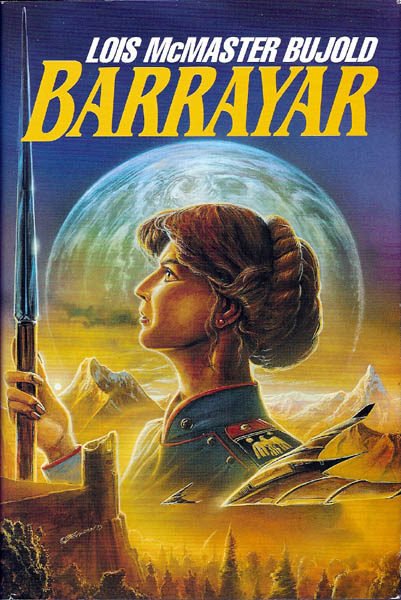
-I am not using this for bingo, but. I got a physical copy via interlibrary loan. Half the cover art was obscured by the interlibrary loan sticker. Which is probably? a good thing? because what in the galaxy is this. I think this would count for the bingo square "judge a book by its cover" but in an ironic way.
primeideal: Lan and Moiraine from "Wheel of Time" TV (lan mandragoran)
 I glimpsed this list of "75 Best Sci-Fi Books of All Time" by Esquire magazine on Reddit (it was published two years ago as Top 50, since expanded). Then @hamsterwoman linked a meme version so now I have motivation to write it up, and wow do I have thoughts. If nothing else, bingo has been good for broad exposure/note-taking so I remember things!
 
Bold: I've read it
Italics: I haven't read this book but I've read something else by that writer
Indents/question marks: I /may/ have read this author but it was at an early age when I was blitzing through a lot of the classics and could not tell you a darn thing about it (there are several of these, I was hungry for SF as a youth but not the most retentive).

If I had a nickel... )
In conclusion, I don't know how anyone does cut text on DW because the formatting is atrocious, and I will buy you as much peanuts, crackerjack, and soma cubes as you can get for ten cents.

Statistics

Jun. 19th, 2024 05:35 pm
primeideal: Lan and Moiraine from "Wheel of Time" TV (lan mandragoran)
...no nation ranks higher in its collective passion for statistics. In Japan, statistics are the subject of a holiday, local and national conventions, awards ceremonies and nationwide statistical collection and graph-drawing contests. "This year," said Yoshiharu Takahashi, a Government statistician, "we had almost 30,000 entries. Actually, we had 29,836."
 
 
Andrew H. Malcolm, New York Times, 1977, quoted in Edward Tufte, "The Visual Display of Quantitative Information."

I'm pretty sure I read a Tufte book (not sure whether it was this one or a different one) six years ago, but I wrote down the title wrong. (I also read a standalone chapter/reprint from another book more recently, which contrasted good use of data display [John Snow researching the cholera epidemic] to bad use of data display [the Challenger disaster]). Anyway, my review from 2018 is definitely the same review I'd give to this book, which is: "Examples of what not to do were good, the suggested “best practices” felt a little radical at times though."
primeideal: Lan and Moiraine from "Wheel of Time" TV (moiraine damodred)
This is a book about some of the main characters in the scientific revolution era--Copernicus, Brahe, Kepler, and Galileo--and their social circles/connections. Copernicus predates the others and didn't have much contact with any of them. Likewise, Brahe and Galileo didn't overlap. Brahe and Kepler were mentor and protege and worked closely together, and Kepler and Galileo were pen pals, so that counts, but otherwise, the "social connections" theme is kind of limited.

The unimpressed reviews on [large review aggregator site] are pretty accurate. One, the aforementioned issue with "they didn't really all know each other." Two, the proportions dedicated to each person are kind of skewed. The author seems to have been interested primarily in Galileo, and secondarily, in Brahe. Really, in Brahe's sister, Sophia, who was an intelligent and hard-working astrologer in her own right. (Tycho considered publishing some of her writings with the disclaimer "I tried to talk her out of it because astrology is kind of laborious for women's brains, but she wasn't going to listen to me." Good guy Brahe supports women in STEM!) So, "the life and times of Galileo and his circle" is certainly enough material for a book in its own right, but it just feels weird to be like "fast forward through Copernicus so we can get to the good stuff."

In general, Fauber is too much in love with the sound of her own voice and literary allusions. There is a lot of material relegated to the footnotes, and a lot of it is stuff like "heehee I couldn't resist a quote from T.S. Eliot here" and...like...you should have resisted. (One of the things that got brought up in history of science class is that as a field of history, it's still very young; a lot of the previous "history" stuff was written by scientists, not necessarily historians. But in this case, the pendulum has swung too far over to the literature people.)

She also had a lot of fun, maybe too much fun, translating/paraphrasing Latin somewhat liberally and showing it off. For instance, on a couple occasions, Galileo published a gibberish anagram claiming priority for his discoveries, so everybody could try to unscramble the letters and guess (a somewhat poetic phrasing of) his result, but only he knew the actual intended solution. Kepler kept trying and failing to solve the anagram. Now, I don't read Latin, so even if I could see the Latin phrases and go "oh, look, same letters, it's an anagram," I would need a translation of both the guesses and the actual discoveries. That's the kind of handholding I want authors to do for me. But instead, Fauber tries to reproduce both (very verbose and over-the-top-flowery) versions in English only, and relegates the actual anagrams to the footnotes! Who is the target audience here?

Then there's a long tangent about Kepler's computations, and I guess what happened is that the editor said "too long, too much math, either cut it shorter or move it to an appendix" and Fauber said "okay, I will cut it shorter and move it to an appendix," so the appendix is just like a longer version of the abridged section, featuring several paragraphs copy-and-pasted, with corresponding exhaustive footnotes.

"I do not mean to construct a world of hysterical suicidal gay nuns" <- one of the asides that got relegated to the footnotes. Feels like a classic case of "this is raising a lot of questions already answered by the footnote."

Anyway, as someone who is much more sympathetic to Kepler than Fauber appears to be, a more engaging book I would recommend that touches on some of the same ground is "The Grapes of Math" by Alex Bellos. The other reviews also pointed to Dava Sobel ("Galileo's Daughter,") which, ditto.

Edit to add: I'd forgotten/hadn't known that some of the characters in Galileo's "Dialogues" were named after his RL friends. I understand that you don't want to name the ignorant Ptolemaic character after anyone you know and like, but I feel like if it were me, I would come up with a better name for that character than "Simplicius."
primeideal: Luke Skywalker and Darth Vader duelling (vader)
AKA more of "things I expect to get around to posting and then never do," but I just found a friending meme in a book discussion community that brought up a couple of these thoughts, so I should probably post them here.

1. In August I read "If on a winter's night a traveler" and mentioned that I'd gotten the recommendation from "Once Upon a Prime" (Sarah Hart). It was extremely meta but also extremely male-gazey. A few months later, I read "Hopscotch"/"Rayuela" by Julio Cortázar, recommended in the same place. This book has a "choose your own adventure" structure--you can read the chapters in order to get a two-part story set first in Paris, then Buenos Aires; or you can follow a zigzag path around the book that includes "supplemental" material at the end. You will notice that I did not review it at the time. That is because I had nothing good to say about it.

The bar for "be less male-gazey than 'If on a winter's night a traveler'" was set on the floor. Cortázar dug down into the basement and the parking garage to go way, way under the bar. "Hopscotch" is for people who think the characters in "La bohème" were too practical and well-adjusted and that we needed artsy-fartsy Parisians with their heads deeper in the clouds. It's "Men Do, Women Are" the whole time. The protagonists' hero is an author who's trying to "destroy" literature by writing a novel that can be read in any order, in order to frustrate passive/stupid/"female" readers who want everything simple. We get it, you're edgy and deconstructive things. The Oulipo did it better! Borges did it better! Calvino did it better without doing it actually well! There were a couple funny chapters near the "end" (in the zigzag order) but it was not nearly worth the 500 page journey.

Bonus content from the three-sentence ficathon.

2. I will probably not review a book if any review I could write would risk falling into Kafkatrap territory. What do I mean when I say "Kafkatrap"?

Let's say a woman writes a novel whose thesis is "men are garbage, even when they mean well, all they do is ruin things." Let's say another woman is reviewing this novel. Her review might lean in the direction of "yeah, the author is right, men are garbage!" Or, it could lean towards "no, this is an unfair generalization, men are not garbage in general." And in either case, hopefully she engages with the case the book makes and points out how it succeeds or fails. Either way, a third-party reader could reasonably read the review and see how it supports whichever side the reviewer comes down on, whether or not they agree.

Now let's say a man has been assigned to review that same novel. Again, his review is likely to boil down to either "yes, men are garbage" or "no, men are not garbage." In the first case, this will be interpreted as evidence in favor of the author's original thesis: "men are garbage, it's so self-evidently clear even a man can admit it!" In the second case, however, this will also be interpreted as evidence in favor of the original thesis: "the fact that this man is unable to accept his garbageness is, in fact, a demonstration of his garbageness." But if agreeing with the author is evidence for the author's claim, and disagreeing with the author is also evidence for the author's claim, then there was no point in the review in the first place. The claim is unfalsifiable, at least by a man!

3. I read "The Ministry for the Future" by Kim Stanley Robinson in/around November 2022. Robinson is a writer of a trilogy about Mars, which I have not read, but which inspired some of the worldbuilding in the boardgame "Terraforming Mars," which is great. So for that alone, I will give him props.

Some of the book is not really written in a traditionally novelistic style. It's more thought experiments with nonfiction prose, infodumping technological and/or economic alternatives to the dominant system right now, or "conversations" among people sitting in a room. Like this. Who don't have. Or need. Quotation marks. Or individual names. Or separation of thought. Because it's not about actions of a single person that matter. It's the zeitgeist. Collective change. Is necessary. To escape. Our crisis.

This writing style. Doesn't really. Work for me. But. If that. Were the worst part. Of the book. I'd probably. Have written a full-length review. At the time. Anyway. Because you can critique it.

The prose/narrative/character/more traditional chapters. In the book. Are worse. Than that. But. I can't. Do justice. To how bad. It was. Please see. Point two.

4. I've been holding off on discussion of another recent read because I thought it would come up for a "two canons, one description" game on anonmeme chat, but anonmemes are also wretched hives of scums and villainy, so. Let's play. Name two canons that feature:

-Setting is New Zealand but definitely not the present-day.
-not a traditional body-swap trope but definitely body-swap adjacent trope vibes.
-a lot of elaborate planet-based symbolism.

Spoilers )

5. Tangential to 4, but if you're a copypasta math spammer from anonmeme, come say hi in namespace? I can't promise to understand weird set theory conjectures but I'm, like, a couple degrees of separation from some of the set theory people who get namedropped ;)

6. Someday I might work up the nerve to surreptitiously signal-boost an anthology I'm involved with in other-name-space, but today is not that day haha
primeideal: Egwene al'Vere from "Wheel of Time" TV (wheel of time)
This book, man, this fricking book.

Important: this is a reread. I'm pretty sure the first time I read it was over a decade ago and I was an undergrad at the time. I think it is, on some levels, amazing and mind-blowing and very well-done. I have a lot of high praise for it. Again, this post is going to probably be disproportionately focused on things that didn't work for me, then and/or now, but that's more about my emotions and less a fair assessment of its literary merits.

The concept: Erasmas is a young "fraa" or "avout" in a "concent" on the planet of "Arbre." The concent is where all the intellectual sorts in Arbre hang out. They go in and take vows that separate them from the "Sæcular" world, so they can focus their attentions on philosophy, math, science, that kind of thing. They spend a lot of time talking about eponymous concepts like Plato's Cave or Ockham's Razor or the Pythagorean Theorem, except Arbre isn't Earth, so they don't have a Plato or an Ockham or a Pythagoras, everything has different names. Depending on how deeply they're embedded within the concent, avout can only emerge for a period of ten days every year, decade, century, or millennium. As our story begins, Erasmas ("Raz") is eighteen, and it's the end of the year 3689; when the (enormous, brilliantly complex, work of art) clock strikes 3690, it will be a new decade, and he'll get to go outside and see his family and the world for the first time in ten years. Which he does. Then things get weird.

Okay, so. Some of the words, you will recognize as being familiar to but not exactly words in our world. "Fraa" ~ "friar," "avout" ~ "devout" or "avowed," "concent" ~ "convent" or "concentric." Even the title: "anathem" ~ "anthem," "anathema." This is all on purpose. People who don't like neologisms in their books probably won't like this book, and that's okay. This is not a criticism I have.

The first chunk of this book is, from a worldbuilding perspective, very fun and cool because MATH MONKS. The concept of the centenarian and millenarian communities remaining in seclusion and pushing forward the boundaries of knowledge is fascinating. The elaborate descriptions of the gothic architecture, the bells, the clockwork, the rituals, the music...it's the kind of place I want to visit, even if I wouldn't necessarily want to live there. A little like Ender's Game, sometimes the jargon can throw you into the world a little abruptly, but once I'm in, I like it, and sometimes resent when the plot moves on and drags me away from the cool concent stuff.

A couple subtweets: if you're a math and change ringing nerd and somehow haven't read this book yet, I highly recommend at least the first chunk. Because change ringing!!! If you're a river rafting guide, I can't recommend this book just for the person of Yulassetar Crade, because it's a very long book and Yul is a very minor character. I can, however, tell you that Yul is the kind of wonderful, self-reliant, adventurous character who has an exciting job where every day is a new challenge that brings the potential for a new story. Yul is great.

So.

Spoilers and rants about many things )

The most important thing I would have wanted to know when I read this the first time is that change ringing with mathematical patterns is real, you can do it in this universe! I didn't discover my college's tower until almost too late, but now I'm slowly picking it up again, and handbells/online ringing give the opportunity to learn the math without the coordination. :D
primeideal: Egwene al'Vere from "Wheel of Time" TV (wheel of time)
This is a reread, I read it as my choice from a list of options for our final project in AP Lit (twelfth grade English), where it was by far more enjoyable than everything else on the syllabus that year combined. The prosody of the end is lovely and has stuck with me, so I figured I'd revisit it.

Knowing what to expect (most of the book is out of chronological order, you can piece it together but it doesn't really matter, the end when it drops the nonlinear stuff is also when the mood whiplash to horror hits) made it less of a roller coaster. (The edition I checked out had a bunch of essays/commentary at the end, including a very detailed spreadsheet that Heller used to keep track of characters and their chronological plots!)

I guess the parts that I'd forgotten are 1. some of the "twists" are not actually twists in that they're essentially spelled out pretty early on, and 2. even the sympathetic characters who get screwed over by the system can also be total jerks (Doc Daneeka has a constant routine of "you're telling me about your troubles? what about me?"; Yossarian and Dunbar grope and harass nurses in the hospital, and I don't think that's entirely supposed to be values dissonance, even if it somewhat is).

-There are creepy ominous people harassing the chaplain in the basement. A psychiatrist interprets Yossarian's mentions of Dunbar as a shadow self: "I'll bet Dunbar is that evil fellow who really does all those nasty things you’re always being blamed for, isn’t he?” And the bizarre illogic that nevertheless makes its own internal sense...what does the Wayside School kid to Catch-22 adult pipeline look like?

-I normally am not a big fan of Good Feels Good/Evil Cannot Comprehend Good tropes, sometimes it feels too easy to have people just enjoy being empathetic without sacrificing anything. But especially recently, in twisted/dystopian settings, there can be thoughtful portrayals of "maybe the bad guys are just angry all the time because they resent the good guys having integrity."

There were many strange things taking place, but the strangest of all, to Clevinger, was the hatred, the brutal, uncloaked, inexorable hatred of the members of the Action Board, glazing their unforgiving expressions with a hard, vindictive surface, glowing in their narrowed eyes malignantly like inextinguishable coals.

Compare "The Master and Margarita": "There was something uncommonly fake and uncertain in every line of these articles, despite their threatening and self-assured tone. I kept thinking—and I couldn’t rid myself of the thought—that the authors of these articles weren’t saying what they wanted to say, and that that was why they were so furious."

I'm not calling myself a paragon of bravery, or anything, I'm a very quiet and conflict-averse person. But man, it isn't hard just to keep your mouth shut sometimes rather than say things you don't believe! I'd be angry too!

Edit to add: this part was too real. (Cathcart is the terrible officer who keeps trying to raise the number of missions required, because he wants his squadron to be famous for "his" bravery and get his name in the Saturday evening post.)
Colonel Cathcart was impervious to absolutes. He could measure his own progress only in relationship to others, and his idea of excellence was to do something at least as well as all the men his own age who were doing the same thing even better. The fact that there were thousands of men his own age and older who had not even attained the rank of major enlivened him with foppish delight in his own remarkable worth; on the other hand, the fact that there were men of his own age and younger who were already generals contaminated him with an agonizing sense of failure and made him gnaw at his fingernails with an unappeasable anxiety that was even more intense than Hungry Joe’s.

I've definitely been guilty of this and hopefully this is a good reality check, because nobody wants to be Cathcart.
primeideal: Luke Skywalker and Darth Vader duelling (luke)
One of the fundamental genre constraints to historical fiction is that, if you're describing large-scale historical events with famous people, your readers often know how it will turn out. So if you want to create tension or suspense, you have to do it some other way, maybe smaller and more personal stakes. A great example, which I'll come back to, is "Ninety-Three" by Victor Hugo. I think everybody who sits down to pick up a book with Robespierre, Marat, and Danton, knows what's going to happen in the general "republicans versus monarchists" battles. Even on the specific scale of the Vendée war, the republicans have a huge advantage both in numbers and technology. We're not in suspense about the campaign. But we are in suspense over the fate of three young children who have been kidnapped and taken hostage by the monarchists.

"The Celebrant" is a book I'd heard of a long time ago because it's been excerpted/quoted in a couple of my (many) anthologies of baseball literature. I knew it was a work of historical fiction, dealing with a Jewish-American immigrant family's assimilation to New York City in the early 1900s, against the backdrop of Christy Mathewson, a brilliant pitcher for the New York Giants. (Mathewson and all the baseball people in the book are real.) What I hadn't remembered/osmosed is that it was written in the 1970s/80s, not contemporaneously to the events it describes.

A celebrant is a person who celebrates. Giants fans are celebrants when the team wins a big game, but Mathewson, despite his book-learning and occasional otherworldliness, is also one of the guys; after a hard-fought poker game or checkers match, he can be a celebrant, too. But--in another "extremely on-brand for me" moment--one of the reasons I keep remembering to put this on my TBR and then go "eh, maybe after bingo" is the other context of the word "celebrant"; in Christian denominations like Episcopalianism, the pastor who says the blessing over Communion is the "celebrant." (In the Lutheran churches where I grew up, we would usually say "presiding minister.") It's a sacred act of emulating Jesus' sacrifice. So week in, week out, I keep seeing that in the bulletin and being like "yeah, I have to track down that Mathewson book, don't I..."

The main timespan of the book covers seasons from 1901 through 1919. Here are some of the names you will find in this book: John McGraw, "Iron" Joe McGinnity, Jake Stahl, Connie Mack, Johnny Evers, Hank O'Day, Honus Wagner, "Smoky" Joe Wood, Tris Speaker, Hal Chase, Joe Jackson, Harry Frazee. If any of these names mean anything to you, you already have some sense of what the baseball-related sections are going to cover.

If none of those names mean anything to you, you probably are not going to enjoy this book, because there is a lot of baseball. Diligently-researched box scores and replays. Sometimes, when the narrator is summarizing a season or two, it can almost read like nonfiction, and those parts weren't as engaging for me, maybe because I've read so much baseball nonfiction before. (Although, when people try to "spice up" their nonfiction by throwing in a bunch of fun facts about who was president or what was going on in pop culture or other trends to set the stage, that annoys me even more.)

If none of those names mean anything to you, but you're confident you would love reading 280 pages of baseball minutiae (there's been a lot of baseball since Greenberg's day, it's entirely possible there are avid fans who don't care about anything that happened in the segregated era!): for the sake of my own curiosity, I would love to hear about your reading experience if you skip the biographical note at the beginning and the line scores/game summaries at the beginning of chapters, and go in completely blind except for stuff like "in 1901, the National League that we currently know exists; the New York Giants are the team that will later play in San Francisco; the American League has just been founded but the NL doesn't recognize it as legit yet."

But yeah, I think for most of us, asking "will McGraw win a World Series?" is about as moot as "will the revolution triumph?" What we care about boils down to something much more personal, which is, "what will happen to Jackie and his relationship with Mathewson?"

The narrator, Jackie Kapp | Yakov Kapinski, is almost the same age as Mathewson, and an avid fan. As a kid, he could pitch a little himself; as a teenager, he gets to shake hands with a big-leaguer who has some life advice for him: "At the dinner, his eyes never leaving the page, he delivered a speech analogizing baseball and life. Practice, dedication, clean living, and fair play—these guaranteed success on and off the field."

But Jackie blows out his arm and never advanced beyond amateur status. So at first glance, it seems like they epitomize the Quester/Family Person dichotomy--Mathewson, the pitching genius, represents the road not taken for Jackie, who has to console himself with a wife and kids.

But it's not that simple. Jackie isn't a ballplayer, but his dedication and passion for his art (his family runs a jewelry business that grows slowly over the course of the decades) is a reflection of Mathewson's brilliance. All his best pieces are spontaneous tributes to Mathewson, but he can't replicate that kind of art on demand. In his own way, he's a Quester, too. And while he tells himself that being a Family Person is worth the tradeoffs, it comes across as very perfunctory to the reader. It's just, like, "timeskip, that girlfriend I have? We're engaged now. Timeskip. Oh by the way she's pregnant. Timeskip. Yeah we had another kid." In an American intergenerational baseball story, like, of course the child has to grow into manhood to have a son and pass down the game to the next generation, that's on the bingo card. But, spoilers, the daughter doesn't exist to do anything except get fridged and give Jackie manpain. Sigh.

Jackie adores Mathewson; his business-minded brothers, and almost everyone else, are like, "that's great, let's find a way for you to get into the clubhouse and shake his hand, it'll make you happy and be good for business."

 
“I don’t want to be his friend at all.”
A secret admirer?”
“No secret to it.”
“What, then? A worshipper from afar?”
“Isn’t that the proper distance for worship? You don’t crawl into the ark to worship
torah.”
“No, but you touch it when it’s walked through the temple.”
“I’ve never liked that, people climbing all over one another while the scrolls are paraded through the aisles. It’s not dignified.”
“It’s emotion, sport, like cheering at a ballgame.”
“I suppose.” I shaded the drawing on my pad. “Eli, you don’t really think I worship Mathewson, do you? In the religious sense? That’s heresy.”
 
There's the old trope about "the only person worthy of power is the humble person who believes they're unworthy of it." Well, that's kind of what happens here, except instead of power it's Mathewson's admiration and friendship, and Jackie keeps shying away and sending gifts indirectly instead. The one time they do talk, of course, there's mutual respect and camaraderie, and Mathewson deconstructs the "baseball is like life" cliches:
After all, baseball isn’t anything like life. I think that was your point, sir, when you said there’s nothing real about it. In that sense I agree. In truth, nothing in the game appealed to me as much as its unreality. Baseball is all clean lines and clear decisions. Wouldn’t life be far easier if it consisted of a series of definitive calls: safe or out, fair or foul, strike or ball. Oh, for a life like that, where every day produces a clear winner and an equally clear loser, and back to it the next day with the slate wiped clean and the teams starting out equal. Yes, a line score is a very stark statement, isn’t it? The numbers tell the essential story. All the rest is mere detail.
Towards the end, the character of Hugh Fullerton (a baseball journalist, also from RL but not someone I was very familiar with), emerges as sort of a reader stand-in, incredulously going "what do you mean you barely spoke to him." You (or at least I, maybe not Fullerton) want to shake Jackie by the shoulders and go "he's made it perfectly clear he understands your art as well as you understand his, go be his friend! Now! Before it's too late!"

In "Ninety-Three," Cimourdain is Gauvain's mentor, best friend, father-figure, etc. They're incredibly close. Gauvain would never do anything with the purpose of harming Cimourdain, just like Jackie would never do anything with the purpose of harming his brother or family. And yet, Gauvain's ultimate loyalty has to be to the visionary republic ideals, even if it brings Cimourdain grief. In the end, Jackie's ultimate dilemma is much the same;
“It isn’t Eli who stands on the precipice,” he said. “It’s you, you, who sways there. It’s you that risks damnation. Do you see that? How can I teach you?”

There are a couple names that I did not include in that big list of characters, that you might expect to show up if you know a lot about early-1900s New York Giants folklore. Spoilers: they do show up. But baseball is a complicated game, and for every dramatic, headline-making play that alters the path of a pennant race or postseason series, there are a dozen others that have just as much influence on the final standings, but don't get the press. In recollections after the fact, people will often say, "yeah, [foo] got a bad rap for how things played out, but you really also have to credit the decisive brilliance of [bar], it's not fair that we're still talking about foo." Except, in that sentence, you've already mentioned "foo" twice. People's brains are weird, especially when you're trying to debunk things! How do you reframe, or retell, that history, to put the emphasis on bar where it should be, rather than foo? A century later, baseball fans would still love to know this. (So would many other people, for that matter.)

Greenberg notes that one of his main sources was "The Glory of Their Times," by Lawrence Ritter, which is a classic (1966) oral history from many of the contemporaries. This was a book I didn't read until I'd read many other, more recent, baseball books, but as soon as I read it it's like, "oh, this is what they're all using as a source, in particular, when the players say 'we talk a lot about foo but we should talk about bar also,' the successors/ripoffs are just like 'foo! okay, moving on now.'"  One thing about baseball is that it is extremely allusive, and reading one story like this will bring up several others. Smoky Joe Wood, a Red Sox star and hero of the 1912 World Series, gets interviewed in "Glory of Their Times." In 1981, Roger Angell--inspired in part by reading that book--tracked him down and talked with him at an epic college playoff game where Ron Darling pitched against Frank Viola, which got turned into a news article. Darling and Viola both become major league pitchers, won the World Series in different years, and played together on the Mets. Angell lived to be 101, and when he died just a couple years ago, there were lots of tributes quoting that story and the 1975 World Series and many others...

And it reminded me of another Mathewson story, originally written by Ring Lardner, collected in a humor anthology. An intro to that chapter/section mentions that "Lardner's tongue-in-cheek elegy has been quoted frequently as a solemn eulogy." But, okay, that blurb is several pages before the excerpt itself. And "elegy" and "eulogy" mean basically the same thing. And yes, there is some over-the-top verse with the "news article," but a lot of actual attempts at serious news in those days also featured over-the-top verse. And the anthology was put together long, long after the fact, once a lot of context had been lost, and I was too young to pick up on a lot of sarcasm in those days. And--spoilers--Mathewson did die prematurely, but not because of the circumstances described in the article. (Well, Greenberg's fictionalized version may have had a more explicit death wish.) Anyway, this is the opening paragraph:
"The baseball world was shocked yesterday by the news that Christy Mathewson, one of the game's greatest exponents, had signed to manage the Cincinnati Reds at the age of thirty-seven years, the very prime of his life. Mathewson is the seventh prominent baseballist to succumb to this disease in a space of twelve years."
Get it? It's a joke that the Reds are very bad. That's it, that's the joke. I think I understand the joke now a lot better than I did when I first read the anthology.

Speaking of humor, "The Celebrant" has a couple uproariously funny scenes--Jackie's businessminded brother, Arthur, accompanies him and their older brother on a trip to Wanamaker's in Philadelphia and tries to improve their company's data collection, and they are...not ready for that mindblowing level of data science. Then there's also an argument between John McGraw and an umpire that is not at all safe for work but very amusing. (McGraw was a small, belligerent, manager from Baltimore who loved small ball, hit-and-run, bunting type stuff, and fighting with everybody all the time. Mathewson was a cerebral college man. Despite Jackie's skepticism, opposites attract and they were an intense bromance, because they were both consummate competitors. Joe Posnanski points this odd couple dynamic out in his "Baseball 100"--Greenberg really didn't need to do any fictionalizing here, except maybe to lean into some of the "oh yes we're ~very close, we lived together with both our wives, wink wink" aspects.)

Okay, so: does "The Celebrant" stick the landing? I don't know--does "Ninety-Three"? Cathartic, in some sense of the word, sure. (I'm good at the "getting filled up with emotions" part but not "and then dumping them out" part.) Bittersweet, yes. Number of sympathetic adult main characters left standing? No comment.

But the real Mathewson, despite the tragedies in his life (his two RL brothers don't make the fictional version, Jackie's family gets the tragedy instead), seems to have been somewhat more hinged in the timeframe of the last chapters than the fictional one. Maybe I can be grateful that, at least, he took the game seriously and was devoted to truth all through his life, or relieved that he never actually had to deploy intermediaries to track down a doppelganger who was too shy to be his friend. Or maybe this is all something I tell myself to keep from having too many emotions about fictional characters.
primeideal: Shogo Kawada from Battle Royale film (battle royale)
I tried a different Kay book a while ago and bounced off it pretty quickly because it was too much of an expy world--like, here's fantasy!Spain, there's fantasy!Turkey, that's fantasy!Italy. I'd prefer either more clearly this world ("Uprooted" does this well) or more clearly a secondary world than the uncanny valley in between. This one is better in this regard, it's kinda sorta not really fantasy!Italy (...in the southern hemisphere). And the first section, well, it really grabbed me. The highs are very high, but the lows are also pretty low. So this will be a long (and spoilery) ramble.

The highs:

-very strong prose and wry humor. In the first few chapters, we meet a young bard whose age everyone underestimates (I can sympathize), and the POV is very clever.
What, Devin d'Asoli asked himself grimly, did a person have to do to get a drink in Astibar? And on the eve of the festival, no less!

...Morosely he filled his glass again. Looking up at the blackened crossbeams of the ceiling he briefly contemplated hanging himself from one of them: by the heels of course. For old time's sake.

Devin also knew, by the smoldering look the Sandreni scion gave him from within the smeared dark rings around his eyes, and the scarcely less transparent glance from Morian's fat-fingered priest--why in the name of the Triad were the Triad so ill-served!--that though they may have just won the Sandreni contract he was going to have to be careful in this palace tomorrow. He made a mental note to bring his knife.
(The last being a very indirect way of saying "why are all the gay men trying to flirt with me," hold that thought.)

-Outsider POV. Devin gradually comes to overhear a plot against the tyrant Alberico, who rules half of the peninsula, and gets dragged into the proceedings. Seeing other minor characters' POV on the main protagonists, we slowly get a sense of how the same person can wear different guises and indirectly act to stir up tumult.

-The depictions of what music means to several characters are compelling without being overly cheesy or sentimental.

-The magical worldbuilding is good. Wizards have to mutilate their hands so that their shape mimics the land itself, it's a little similar to "Elantris" but with more body horror. Kay ropes in everything from Marriage to the Sea to speculative studies of magical? folklore to the mythological trope of the death-and-rebirth god, and at times it almost feels like it's too much and won't necessarily hold together, but it does.

-Funny tropes like the "uhhh we're just...sneaking around in a secret passage...let's be very very quiet by...having sex. Yes, sex," and deliciously iddy dark tropes.

Okay, so that's all great, where does it go wrong.

-The primary motivation for the main characters is avenging their fallen homeland. In the dim and forgotten days of memory (...18 years ago), two tyrants came from overseas and chopped up the provinces of the peninsula between them. They now have an uneasy balance of power, to the point where if one of them were to be assassinated, the other would probably just become dictator of the other half; the rebels are plotting to weaken and then depose both at once, because that seems like the best way to a long-term peace. One of the provinces, now known as Lower Corte, suffered a more brutal oppression than the rest; it used to be named "Tigana," but the dictator (Brandin) on that half was so furious with that province that he wiped their name from memory. No one who isn't originally from Tigana can hear that name, it just sounds like nonsense. So they're fighting to avenge their Worse Than Dead Homeland.

Okay. For the purposes of a fantasy novel, I'll allow the suspension of disbelief of "these tyrants are bad, our prince will be a good and noble prince, we have to overthrow the bad kingdom to put in the good kingdom." But I can't buy that the effacement of Tigana is so uniquely bad, so horrifically bad, that the need for vengeance is so deep and urgent. Kay points out in an afterword that non-magical versions of this cultural displacement happen IRL, which is definitely true! Whether with language policy or just the violent aftermath of colonization in general. Colonization is bad. But is the response "our national identity is so good and true that we must restore it?" Maybe I'm biased, but I don't really think anybody's national identity is that great. Certainly, mine isn't--I'm the descendant/beneficiary of colonizers. Maybe it would be good if someone blotted any sense of connection I had to my homeland and gave me a clean slate! Or maybe the descendants of people my ancestors oppressed would love to get their vengeance on me, but they can't because magic isn't real. What kind of a monster does that make me? Worse than Brandin?

(To Kay's credit, there is a character who calls the protagonists out on this, and by the end both he and the other protagonists have altered their views somewhat, in a way which I thought was realistic. But still, this "annihilated homeland" is the impetus of the entire plot, so it's worth pointing out that my suspension of disbelief failed there.)

-There is another plotline that also features its own mix of intriguing POVs and prose. Dianora, a young woman from Tigana who lost her family when the tyrants came, had the same dream that all the other protagonists shared--avenging her homeland, even if it costs her her life. She spent the first six-ish years of the occupation slowly maneuvering to put herself into a position to get close enough to Brandin; then serendipitously happens to get kidnapped to join his harem. Great! Problem solved! After a few pages worth of eunuchs and other descriptions of things that happen in harems...at some point...she should...get an opportunity, right? Nope. She agonizes over her attraction to Brandin and her conflicting duties for twelve years, then saves his life from an independent assassination attempt. Then steels herself again (hold that thought too) to try and destroy his imperial ambitions. Fails again. There are hundreds of pages of Stockholm Syndrome that could be cut with no actual difference to the plot. (Dianora is not in on the "we need to take them both at once or we'll just trade one dictator for another" calculation, so by preventing Brandin from dying earlier, she arguably helps the cause for balance-of-power reasons, but that's in spite of and not because she's trying to.)

-The two plotlines almost come together at the end, and it looks as if, hey, they might actually combine and people will maybe get closure/family reunions? There's a very cool twist that I did not see coming and that part stuck the landing very well. Okay, maybe that will also lead into...Nope, nope, the characters have an opportunity to reconnect and get closure and Kay is like "no closure for you, lol." Then he throws in some ominous foreshadowing/cliffhanger in the very last sentence. Do not want!

-Okay, how does Dianora steel herself to try again? She remembers her darkest and worst secret from the early months of the occupation, which is...that when she and her brother were teenagers...they had sex. Because political oppression leads to incest (and uncomfortable kinky sex in general). I??? What??? Did this come out of the worst "Cards Against Humanity" game ever played??

-On the subject of sexuality in general; some people are gay, that's how they are, and some other people are playing up the stereotypes of being over-the-top effeminate gay men in order to make them appear nonthreatening. It's a little stereotypical for a secondary world that doesn't need to have our stereotypes, but okay, it was 1990, gay rights have come a long way in 34 years.

Spoilers, again: I was giving Kay a lot of credit for complicated, subtle depictions of sexuality, based on this paragraph:
 
"Intercepting the look that passed between them [two main characters, both male] then, Devin learned something new and sudden and unexpected--on a night when he'd already learned more things than he could easily handle--about the nature of bonding and about love."

I'm not always the best at picking up on subtext or seeing why other people ship characters that I read as platonic. But given the fact that Kay uses the word "love" when many authors are squeamish about it, and given the way the prose is handled, oftentimes with wry distance--this seemed to me like a pretty unambiguous communication that They Are Life Partners In Every Way. In the context of the "political repression leads to screwed-up sex lives" assumption, I could even interpret it as "just a phase"--maybe one or both will choose to sleep with a woman and have children specifically for the purpose of renewing the nation/monarchy/fertility rites idk. But the book swerves to "nah, at least one and probably both have women they like even when it's not ~special magical fertility rite~ season." That kind of...surprised me. IDK, I guess I'm more used to reading with 2020s sensibilities.

Neither good nor bad but just kinda noteworthy:


-The depiction of religion is interesting, like I said; there are two goddesses and one god; the clergy for each deity are always the opposite sex. The narration points out that, while the tyrants were very intent on crushing out patriotic opposition (especially in Tigana's case), their relationship towards the clergy is like "meh, do whatever, carry on as you always have, we don't want to get on your bad side." This seems to be portrayed as a bad thing--like, the clergy are so corrupt, they'll compromise with tyrants. Couldn't it be a case of "even tyrants fear the power of faith because people really do believe it?" IDK, it seems kind of glib "religion bad, patriotism good," but I was already reading with bias by then.
-One of the epigraph quotes is from Dante's Paradiso, when one of his ancestors is prophesying Dante's exile from Florence. Serendipitous timing because I just got there in the readalong :)
-Brandin's homeland is named "Ygrath." Fine, whatever. The other tyrant comes from "Barbadior," land of the "Barbadians." This seems...unnecessarily similar both to "barbarians" and RL "Barbados"/"Barbadians" (that's their real demonym!) Like, Barbados is definitely not a colonizer society. Quite the opposite, in fact! That threw me out of the story a little.
-"And somewhere in his mind and heart--fruits of a long winter of thought, and of listening in silence as older and wiser men spoke--Devin knew that he was not the first and would not be the last person to find in a single man the defining shape and lineaments for the so much harder love of an abstraction of a dream." The character Devin is admiring here is indeed a good and admirable man who could easily command his loyalty, and the conclusion--it's easier to give your loyalty to a person than an abstraction--could easily be the thesis of a different story. But this one? I think this line works against the themes of the rest of the book, which is that giving your love to an abstraction or dream (if that dream is your memory-wiped homeland) is pretty darn easy, actually.

tl;dr I will definitely try Kay again because the prose and first act really were that compelling, but it did not follow through.
primeideal: Lan and Moiraine from "Wheel of Time" TV (moiraine damodred)
This book is better than I'm making it sound. I have a small quibble with it, but it's one of those quibbles that I can't be concise about so I have to spend a lot of words on a digression or two before getting to the nitpicky point.

racism? bad. sexism? also bad. )


primeideal: Egwene al'Vere from "Wheel of Time" TV (egwene al'vere)
  • The subtitle of the book suggests that it will be about pocket calculators. Actually "the world's first pocket calculator" appears on page 201 of 278 (excluding endnotes). The scope of the book is much broader, in terms of "tools people use to help them calculate," from the abacus through spreadsheet applications.
  • The writing style is kind of tangential, not in a pretentious "let me show you my learnings" way but in a rabbit-holey "let me show you my learnings" way.
  • The layout of the book has pretty chapter art, which is cute and a nice touch.
  • There's a cool diagram of Pascal's triangle (which, of course, was not originally discovered by Pascal) using Chinese counting rod numerals, published in Japan in 1712. (Similar to this, although this one is even earlier, from 1303.)
  • Johannes Kepler gets a shoutout, which may or may not be useful for fiction purposes.
  • The description of slide rules and their basis in logarithms was useful as well, as someone who is too young to have used a slide rule :)
  • The second half is a little dryer than the first, more corporate-speak. The focus-but-not-really on "pocket calculators" means he has an excuse for fast-forwarding through a lot of computer development, but there's less of a clear narrative.
  • Grace Hopper did not define the "mechanical error" sense of a "bug" (Thomas Edison used the word in a similar way in 1878); she did, of course, immortalize the irony of "the problem this time really was caused by a moth!"
  • Just in general, "pocket" size is really limiting. Especially for women who already don't have enough pockets :P
  • There are a couple cases where the author points out "yeah we don't even know anything of the woman who made this suggestion/this inventor's mother, society is really sexist sometimes :("
  • A quote from an engineer who worked on the Sumlock ANITA in 1961: "Experienced calculator operators were slow to appreciate the technological breakthrough because they could not get used to the lack of 'feel' and noise that was inherent in mechanical machines. The same phenomenon was experienced by typists changing from manual to electric typewriters." The same issue we have today with electric cars!
primeideal: Luke Skywalker and Darth Vader duelling (vader)
For posterity's sake: I wrote up a longish piece about why I take an optimistic interpretation of "Death's End" on Reddit here. These are all thoughts I've been turning around in my head for a while but I can be a bit insecure about posting my optimistic takes amid the Reddit dudebros, hopefully they are all too busy getting drunk for New Year's Eve to downvote it ;) But I had a comment to someone else's post with a tl;dr version of this that got a good response, so I finally got around to it.

Includes discussion of Douglas Hofstadter's analysis of the prisoner's dilemma, as previously seen here.
primeideal: Wooden chessboard. Text: "You may see all kinds of human emotion here. I see nothing other than a simple board game." (chess musical)
Once upon a time, the space empress died. But don't worry, she left a very clear will leaving the empire to her favourite. Even his enemies have to agree the will is unambiguous and foolproof. Her intent, the letter of the law, and imperial Convention (always capitalized) mean that Keira gets to be the new emperor.

But, just in case, he shows great magnanimity and extends an offer to any other aristocrats to challenge him for the throne. Now, in the space empire, everyone takes noblesse oblige very seriously; we can't have ordinary war, because in war, commoners die, and that's very bad. So several aristocrats challenge him to various video game simulations. He wins all of them. It helps that he has Talent (also a proper noun), which in this case means "being sometimes able to see into the future and psychically find patterns because all the nobles are weird and inbred like that."

Most of the defeated enemies swear loyalty to him, as per Convention. But Eduoard doesn't and decides to fight a war about it. After consulting with his sister, a space Catholic nun, he starts a small-scale war. Again, Keira uses his Talent and defeats the pretender.

This is like...Dune fanfic by someone who doesn't care about Arrakis. Like, what if space monarchy and space inbred nobles and space psychic nuns? Okay, and?

In Ender's Game, even just the Battle School sequences, we have a sense of the rules of the game. We see enough "normal" (ish) battles to understand the different strategies, and when Ender exploits the loophole with "the enemy's gate is down," it means something. Here, all the video game fights are standalone chapters, and any interesting practice or strategy is just fast-forwarded through offscreen. Keira uses his Talent, he sees a winning strategy, he wins, repeat 4x. ("Guy has to win video games to become space emperor" was the Yuletide promo, but that's overselling it imo.)

There's also a subplot about "was this all set up centuries in the past so my ancestor could win a bet with the ambassador's ancestor?" Involving magically inherited memories that Keira has access through (because of his Talent, of course). Again, the less-interesting (to me) parts of Dune, with a hint of the Mists of Avalon reincarnation nonsense. Towards the end this turns into themes of "why do we even have an empire anyway, isn't this system going to break down eventually," which could be interesting as its own take on the trope (and the cycles of decadence/decline is also a thing in Dune), which sort of makes the end unique, but it's too little, too late.

Eduoard's home planet has a fun holiday for the first snowfall of the year, that worldbuilding was unique and cool. I wanted to see more about what space Catholics actually believe and practice--there's a description of Eduoard's triptych featuring the "Donna" (Virgin Mary) and St. Michael, the warrior angel, which was neat. But again, not enough of this.

Keira comes from a noble house that used to be a big deal before they got demoted. Their name is the Renaults. I think this is the author having fun and indulging her own id, because there's a novelist named Renault who wrote a bunch about the Greek empire.

In Dune, we have planets like Arrakis, Salusa Secundus, and Caladan. Even if a lot of the glossary terms are thinly-disguised space Arabic, there was at least an attempt made to have original-ish proper names. In The Game Beyond, the space settings have names like Castille, Sahara, Babylon, Hell, and Somewhere Else. Hell is at least described as painfully hot (they sleep during the day and go out at night), but there's no real description of these places. It's just..."instead of filing off the serial numbers I'm just going to indulge my own id with imperial extravagance, but in space." Respect the hustle, it just wasn't for me.
primeideal: Egwene al'Vere from "Wheel of Time" TV (wheel of time)
This is what I was afraid "Tress" was going to be.

Tress of the Emerald Sea: Sanderson pastiche of "The Princess Bride" (the movie at least, not necessarily the book)
The Frugal Wizard's Guide to Surviving Medieval England: Sanderson pastiche of "Project Hail Mary"
Yumi and the Nightmare Painter: Sanderson pastiche of "Your Name"
The Sunlit Man: Sanderson pastiche of a Brandon Sanderson book.

Guy running away from a group of people who want to kill him comes to tiny planet that has never known war because everyone is too busy running away from the sun to go pro at killing each other. A few people would like to become pros at killing each other. Unfortunately, the guy who has seized power because he loves the idea of having power proves to have all the flaws of people who love power.

The main character ("Nomad") mentions stuff like "storms" enough that we can figure he's from Roshar, the world of the Stormlight Archives. I figured it out, yay! He also frequently uses "tens" as a unit, where other people might say "dozens" or "twenty to thirty." Does he really not have a word for numbers bigger than ten? No, it's just that "ten" is the arc number from Roshar (the same way sixteen is in Mistborn), the magic-users come in ten classes, etc. Okay, fine.

He is a lot more scientifically literate than the locals, and spends a lot of time trying to figure out what's going on with their planet both in scientific and Cosmere terms. He's a decent enough person that he wants to do the right thing and protect them both from their tyrant and the planet itself, but he is also operating under some constraints because he once held a powerful weapon and it warped him, and also, he's...failed at his oaths?...so he's kind of given up on being a hero.

There is a lot of backstory involving "Auxiliary," the shardblade who he's magically bonded to, as well as the weapon he used to have, which he temporarily borrowed from Hoid (yes, again), and the people who are chasing him. All of this is hinted at in such a way that, because it was billed as "this is one for the Cosmere nerds, here's where it all comes together!" that I was spending the whole time going "okay, should I know who this is? Who was Auxiliary before he became a shardblade? Is this a name I recognize? I know who Kaladin, Dalinar, Adolin, a bunch of the main characters are, but...is Nomad someone I've met?"

The answers: Nomad is a character significantly more minor than these; the other stuff is not covered in Stormlight, so I'm not a dunce for not recognizing it. But to some extent, it feels like, it's too late, I've already formed that impression? Like, it's normal (although sometimes a cheap method) to hide/obscure characters' backstory until later on. But when you're Brandon Sanderson and juggling a gazillion intertextual Easter eggs and callbacks, it doesn't really feel fair to be like "oh haha never mind, Aux isn't someone you've met so far, don't worry about it."

The good news is, while Hoid shows up for like two chapters, he doesn't narrate.

tl;dr if you are on the fence about Sanderson (for some reason) and want to try a single-volume book to see if you like it, start with Tress. Don't start with this one.

Profile

primeideal: Multicolored sideways eight (infinity sign) (Default)
primeideal

March 2026

S M T W T F S
1234567
89 10 1112 1314
151617181920 21
2223242526 2728
293031    

Syndicate

RSS Atom

Most Popular Tags

Style Credit

Expand Cut Tags

No cut tags
Page generated Apr. 2nd, 2026 10:59 pm
Powered by Dreamwidth Studios